

Sometimes, getting something done has little to do with money. The bigger problem is being in the right place at the right time.
A product may be available in a local market, but the customer could be in another city. A gift may need to be purchased and arranged for someone. A forgotten item may need to be collected from a store. A document-related task may require a physical visit. A property may need attention while its owner is away.
In all these situations, the requirement is simple, but completing it personally can be difficult.
This is the problem Shoppin, a Hyderabad-based on-demand Personal Shopper and Personal Assistant service, is trying to solve.
Founded in 2022 by Nishant Parepalli and Shashank Veer, Shoppin helps customers get things done when they cannot physically be present. Instead of asking people to browse a fixed product catalogue, the platform allows them to simply explain what they need through WhatsApp. A real person then works on the request.
The service covers personal shopping at stores and markets, sourcing products from abroad, documentation-related tasks, property management, gifting, errands and other personalised requirements.
Its philosophy can be summed up in one simple line:
“You cannot go? Shoppin will go.”
What began with the idea of personal shopping is now evolving into a broader on-demand human assistance platform. The company says it has already served more than 1,000 customers across India and internationally while building the business as a bootstrapped startup.
The interesting part of Shoppin’s story is not simply what it does, but the gap it identified: there are many things people want to get done, yet they cannot always be physically present to do them.
The Problem That Led to Shoppin
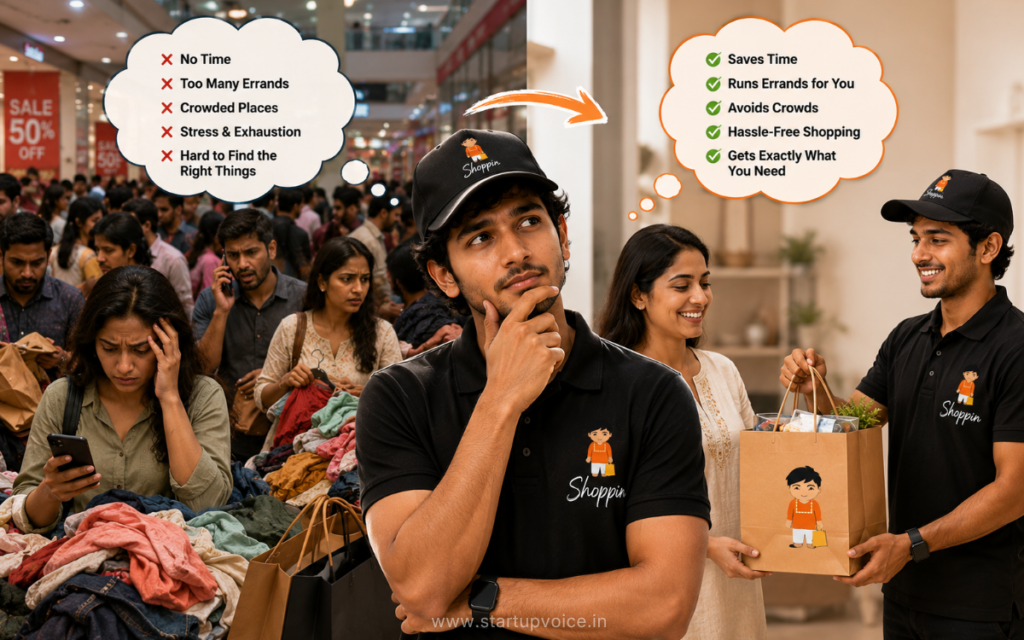
The idea behind Shoppin came from a simple observation about everyday life.
People do not always lack the money to buy something. Sometimes, they simply lack the time, location or means to get it themselves.
Consider a simple shopping task. A person may know exactly what they want, but the product could be available only at a particular physical store or market. Visiting that location might take hours.
The same problem can appear in less obvious situations.
Someone may need an item collected from another place. A person living in another city may need an errand completed in Hyderabad. Someone outside India may need help accessing a product or handling something back home. A property owner may need assistance with a physical task while being away.
These are not necessarily problems that traditional e-commerce platforms are designed to solve.
Online marketplaces are excellent when customers know what product they want and can find it within the platform’s catalogue. But real-world requirements do not always fit into predefined categories.
Sometimes, customers do not need another website where they can search.
They need someone who can go there for them.
That realisation became the starting point for Shoppin.
The founders began exploring a straightforward question:
What if a person could simply send a WhatsApp message explaining what they need, and someone could physically handle it?
That question eventually became the foundation of the business.
From a Shopping Idea to a Human Assistance Platform

Shoppin initially grew from the concept of personal shopping, but the founders soon recognised that the underlying problem was much broader.
The common thread was not shopping itself.
It was physical assistance.
A customer might need a product purchased from a store. Another might need something sourced from abroad. Someone else might require an errand to be handled, a gift arranged or a property-related task taken care of.
Although these requests appear different, they share the same basic requirement: someone needs to be physically present.
This led Shoppin toward a broader positioning as an on-demand Personal Shopper and Personal Assistant service.
Today, the company says it can help with a range of requirements, including:
- Shopping from stores and local markets
- Product sourcing from abroad
- Documentation-related tasks
- Property management
- Gifting
- Everyday errands
- Other personalised assistance requirements
This broader approach is important because it changes how the service is viewed.
Shoppin is not simply asking customers what product they want to purchase.
It is asking what they need to get done.
That difference gives the company the flexibility to address tasks that may not have a standard online solution.
A customer does not necessarily need to know the exact store, delivery process or marketplace where a product can be found. They can communicate the requirement and leave the physical execution to the service.
Why Shoppin Does Not Need a Traditional Product Catalogue
One of Shoppin’s biggest differences from traditional e-commerce is that it does not operate around a fixed catalogue of products.
Most online shopping platforms depend on listings.
Customers search for products, compare options, select an item and place an order. The entire system is built around products already available within the marketplace.
Shoppin takes a different approach.
Its proposition is essentially:
If something is available in the real world, Shoppin can help you access it.
That means the starting point is not a catalogue.
It is the customer’s request.
This can be particularly useful when the requirement is highly specific.
For example, a customer may be looking for something available at a particular physical market rather than an online store. Instead of spending time searching multiple websites, the customer can explain the requirement directly.
The same principle applies to sourcing products from abroad or completing location-specific errands.
This gives Shoppin a different role in the customer’s journey.
Traditional e-commerce asks:
“Which product from our available options would you like?”
Shoppin asks:
“What do you need?”
The distinction may appear simple, but it changes the entire service model.
The company is not limited by what it can place inside a digital catalogue. Its focus is on whether the requested task can be handled in the real world.
WhatsApp Keeps the Process Simple
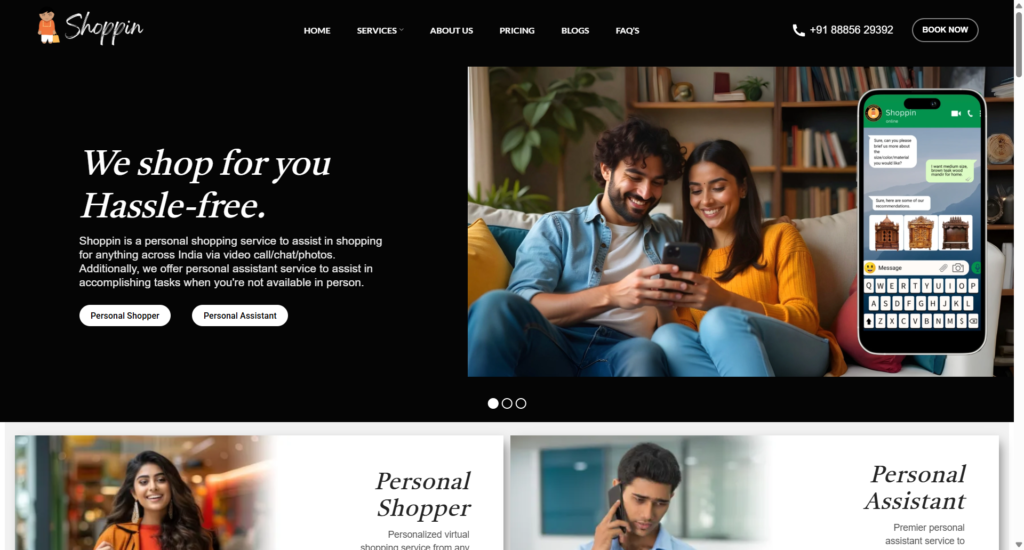
Another important part of Shoppin’s model is its use of WhatsApp.
Rather than requiring customers to learn a new platform or navigate multiple categories, the company allows them to communicate their requirements through a familiar messaging platform.
This matters because many personalised requests are difficult to describe through standard menus.
A customer may not know whether an unusual requirement belongs under shopping, errands, gifting or another category.
With a conversational approach, the customer can simply explain the situation.
The interaction is also human-led.
According to the company’s positioning, customers are not simply talking to a chatbot or browsing another marketplace. They communicate with a real person who understands the request and works on getting it done.
That human element is central to the service.
The experience can be reduced to a simple sequence:
Tell Shoppin what you need → a real person understands the requirement → the task is handled physically.
The simplicity of that process is part of the company’s appeal.
Customers do not necessarily have to solve the logistics themselves before asking for help.
They can start with the problem.
How the Shoppin Service Works
The concept behind Shoppin is relatively simple because the company is trying to remove complexity from the customer’s side.
The process begins with a requirement rather than a product listing.
1. The Customer Shares the Requirement
The customer explains what they need through WhatsApp.
It could be a shopping request, a product that needs to be sourced, a gift that needs to be arranged, an errand or another physical task.
2. The Requirement Is Understood
A real person communicates with the customer and understands the details of the request.
This conversational approach is particularly useful for personalised or unusual requirements that may not fit into a standard category.
3. Shoppin Handles the Physical Task
Once the requirement is understood, the service works on completing it.
Depending on the request, this may involve visiting a store or market, sourcing an item, handling an errand or taking care of another physical requirement.
4. The Customer Gets the Task Done Without Being There
The central benefit is convenience.
The customer does not have to personally travel to the location or spend their own time completing the task.
In simple terms, Shoppin acts as the physical presence the customer does not have.
That is the heart of the business model.
Why the Business Is About More Than Shopping
The name Shoppin naturally suggests shopping, but the company’s proposition has moved beyond purchasing products.
At its core, the business is about saving customers from tasks that require their physical presence.
Shopping is simply one of the most obvious examples.
Suppose someone needs a specific product from a local market. The problem may not be purchasing it. The problem may be reaching the market.
Similarly, a person might need a gift purchased and arranged but may not have time to visit stores.
A property owner may need a task handled at a location while being elsewhere.
A customer may need an errand completed in another city.
In each case, the underlying need is similar.
The customer needs someone to act on their behalf.
This gives Shoppin a broader potential use case than a conventional shopping platform.
Instead of defining itself only through products, the company is building its service around tasks and assistance.
That is also why the term “Personal Assistant” is important in its positioning.
The service is not only about finding things.
It is about helping customers accomplish things.
A Bootstrapped Journey Since 2022
Shoppin was founded in 2022 and has been built as a bootstrapped startup.
The company says it has served 1,000+ customers across India and internationally.
For a service based on human assistance, serving customers across multiple locations represents an important part of the journey.
Unlike a purely digital service where the same product can potentially be delivered to large numbers of users automatically, personalised assistance often requires individual attention.
Each request can have different requirements.
One customer may want something purchased from a market. Another may need a product sourced from abroad. Someone else may require a property-related task or an errand.
The business therefore revolves around responding to individual needs rather than delivering one standard product.
The fact that Shoppin has reached customers across India and internationally also reflects the kind of problem it is trying to solve.
Physical distance creates the need for assistance.
A customer does not necessarily have to be in Hyderabad for the concept to be useful. What matters is whether there is something they need done that they cannot personally handle.
This gives the service a naturally broader geographical relevance.
Recognition Along the Way
Customer service and business development are central to Shoppin’s journey, but the startup has also received external recognition.
The company was nominated for the India 5000 Best MSME Award 2026.
It was also interviewed by Radio Mirchi Telugu.
For an emerging business, such milestones can help create awareness around a concept that is different from traditional online shopping.
Most people already understand what an e-commerce marketplace does.
They understand that a food delivery platform brings food from restaurants.
They understand that a courier service moves packages from one location to another.
But personal human assistance covers a less clearly defined category.
A customer may not immediately think of hiring someone to handle an everyday physical task on their behalf.
That makes awareness particularly important for Shoppin.
Its recognition and media exposure provide additional opportunities to explain what the service actually does and why it exists.
The Bigger Opportunity Is in Everyday Convenience
The strongest part of Shoppin’s idea may be its connection to a universal problem: people have limited time.
A task that takes only a short time to complete may still require significant travel.
Going to a store may involve transportation, waiting and coordination. Visiting a market in another area may take even longer. Handling something in another city can become impractical altogether.
As people’s lives become more geographically distributed, these challenges can become more common.
People work in one city and have family in another. Business owners manage responsibilities across locations. Customers travel frequently. People living abroad may still have requirements in India.
In these situations, physical assistance becomes useful.
Shoppin’s model is therefore built around a simple value proposition: customers can delegate the physical part of a task.
That is different from simply selling convenience through faster delivery.
The company is trying to provide convenience by removing the requirement for the customer to physically be there.
This distinction gives the model room to cover a wide range of situations.
What Makes Shoppin Different
Shoppin’s differentiation comes from several parts of its model working together.
A Catalogue-Free Approach
Customers are not restricted to a fixed list of products.
The request begins with what they need rather than what is already listed online.
Human Assistance
Customers communicate with a real person instead of relying entirely on automated systems.
WhatsApp-Based Communication
The company uses a familiar communication channel to make it easier for customers to explain their requirements.
Multiple Use Cases
The service extends beyond shopping into sourcing, errands, gifting, documentation-related tasks and property management.
Physical Execution
The central value comes from having someone physically handle the task when the customer cannot.
Together, these characteristics position Shoppin differently from conventional e-commerce.
The company is not simply competing to become another destination where people purchase products.
It is building around a different question:
How can we help when the customer cannot physically do it themselves?
The Challenge of Building Trust Into Human Assistance
A human assistance service also comes with an important responsibility: trust.
When a customer asks someone to purchase an item, arrange a gift, handle an errand or take care of something at a physical location, they are depending on that person to understand the requirement correctly.
This makes communication critical.
Unlike a standard online purchase, where the customer chooses a listed product and completes a checkout process, personalised assistance can involve details and preferences that need to be understood through conversation.
The human element therefore works both ways.
It is what makes the service flexible, but it also means that the experience depends on how well the request is understood and executed.
For Shoppin, building a dependable experience around that relationship is likely to remain an important part of its journey as the service expands.
The company is essentially asking customers to trust it with tasks they would otherwise have to handle themselves.
That makes reliability just as important as convenience.
From Personal Shopper to a Broader Platform
Shoppin’s evolution from a personal shopping concept into a wider human assistance platform is perhaps the most important part of its story.
The founders started with a specific problem but discovered a much larger category around it.
The central need is not shopping.
It is access and assistance.
If a customer cannot reach a particular store, Shoppin can potentially bridge that gap.
If someone needs an item from another location, the service can potentially help.
If a customer needs an errand handled, the same model can apply.
This broader positioning means the company’s future is not necessarily tied to the number of products it can source.
Instead, its potential is linked to how many real-world tasks it can help customers complete.
That creates a very different growth story from traditional e-commerce.
An e-commerce platform grows by expanding products, sellers and transactions.
A human assistance platform grows by becoming useful across more situations while maintaining a dependable customer experience.
For Shoppin, that broader direction is already visible in the services it offers today.
Conclusion
Shoppin’s story begins with a problem that is easy to understand: sometimes people want something done but cannot physically be there to do it.
The Hyderabad-based startup, founded in 2022 by Nishant Parepalli and Shashank Veer, is building a service around that gap.
Rather than operating like a traditional e-commerce marketplace with a fixed product catalogue, Shoppin allows customers to explain what they need through WhatsApp. A real person then helps execute the task.
That can include shopping at stores and markets, sourcing products from abroad, documentation-related tasks, property management, gifting, errands and other personalised requirements.
The company says it has served more than 1,000 customers across India and internationally as a bootstrapped startup. Its nomination for the India 5000 Best MSME Award 2026 and interview with Radio Mirchi Telugu mark additional milestones along the way.
What makes Shoppin interesting is the simplicity of the problem it has chosen to solve.
It is not trying to make people shop more.
It is trying to help people do more without having to be everywhere themselves.
As the business evolves from personal shopping into a broader on-demand human assistance platform, its biggest opportunity may lie in becoming a trusted solution for the everyday tasks that technology cannot completely automate.
For customers, the idea remains simple.
You cannot go? Shoppin will go.
➤ Connect with Startup: Shoppin
FAQs
1. What is Shoppin?
Shoppin is an on-demand Personal Shopper and Personal Assistant service headquartered in Hyderabad, Telangana. It helps customers complete tasks when they cannot physically be present. Its services include shopping from stores and markets, sourcing products from abroad, documentation-related tasks, property management, gifting, errands and other personalised assistance.
2. Who founded Shoppin?
Shoppin was founded in 2022 by Nishant Parepalli and Shashank Veer, both of whom were born and brought up in Hyderabad, Telangana. The company is being built as a bootstrapped startup.
3. How does Shoppin work?
Customers can explain their requirements through WhatsApp. Instead of selecting only from a fixed online catalogue, they can tell a real person what they need. Shoppin then works on handling the physical task, allowing customers to get things done without personally visiting the location.
4. What makes Shoppin different from traditional e-commerce?
Traditional e-commerce generally operates through a fixed catalogue of products. Shoppin does not follow that approach. Customers can request assistance for products or tasks available in the real world, including shopping, sourcing, gifting, errands and other requirements. The service is built around human assistance rather than catalogue-based shopping.
5. How many customers has Shoppin served?
According to the information provided by the company, Shoppin has served more than 1,000 customers across India and internationally. The startup was founded in 2022 and has been built as a bootstrapped business.