
When two engineering students from Odisha, Debendra Pradhan and Biswajit Swain, first tinkered with underwater robotics at NIT Rourkela, they couldn’t have imagined the journey ahead. What began as a college project soon became Coratia Technologies, a deep-tech startup now supplying Make-in-India underwater robots to the Indian Navy and industrial clients.
The Beginning of the Startup

The idea sparked during a classroom experiment: designing a remotely operated underwater vehicle (ROV) capable of precise maneuvers. Fascinated by the possibilities, Debendra and Biswajit realized that India lacked indigenous solutions for underwater exploration and inspection, especially in defense and marine industries. They decided to turn their academic project into a viable business, bootstrapping initial prototypes from scratch.
Founder Background and Inspiration
Both founders shared a passion for robotics and applied AI-driven sensors. Debendra focused on mechanical design, while Biswajit handled electronics and software. Their shared goal was simple yet ambitious: build world-class underwater robots in India, reducing dependence on imported technology and strengthening local defense manufacturing.
The Problem the Startup Is Solving
Currently, underwater inspections and naval operations in India rely heavily on imported systems or human divers in risky conditions. Coratia’s robots aim to bridge this gap, offering safer, cost-effective, and locally manufactured alternatives that can perform complex underwater tasks reliably.
The Product or Solution
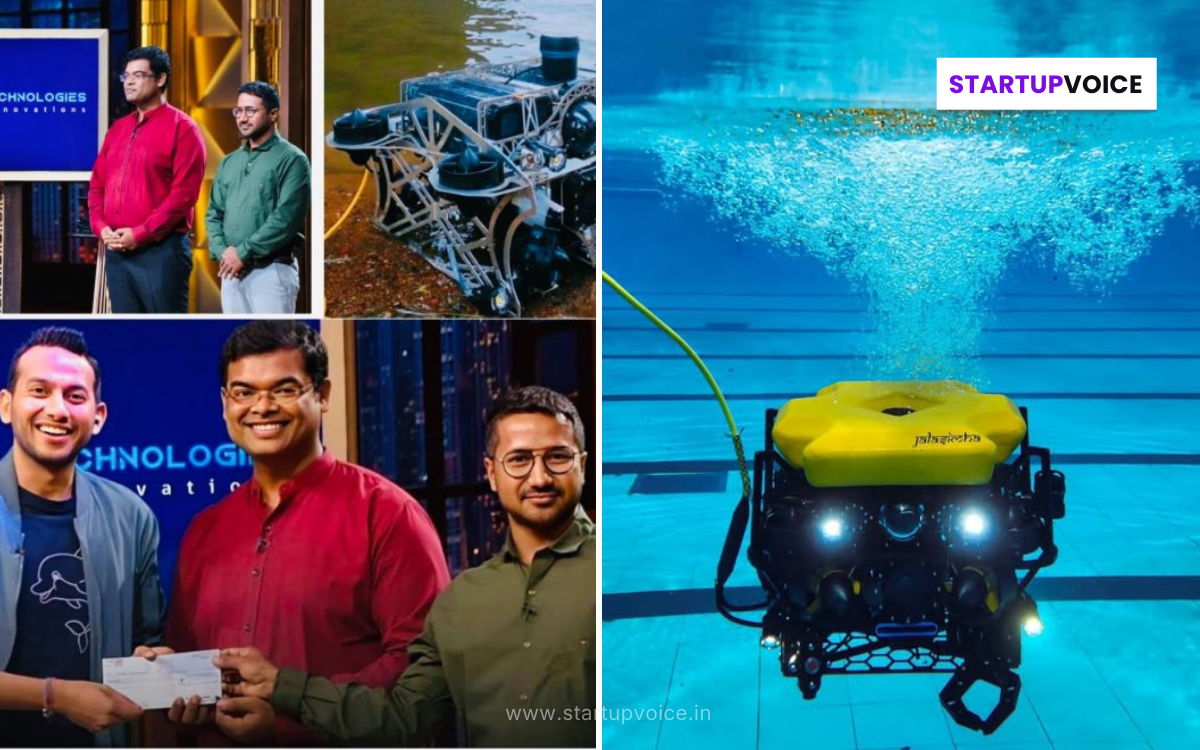
Coratia Technologies designs a range of ROVs. Jaladuta serves industrial inspections like pipelines and dams, while Jalasimha is designed for naval applications, capable of surveillance, mapping, and maintenance. Other products, such as Oceanus and Navya, cater to marine research and ecosystem monitoring. Each robot integrates AI sensors, precise maneuvering, and robust design, enabling long-duration underwater operations.
Business Model
Coratia generates revenue primarily through government defense contracts and industrial sales, supplemented by R&D collaborations with private enterprises. Recent Pre-Series A funding of ₹17.4 crore has accelerated production and technology upgrades.
Growth and Milestones
The startup’s major milestone came when it secured a ₹66 crore contract with the Indian Navy, validating its Make-in-India vision. Beyond defense, industrial adoption of Coratia’s robots is steadily growing, making the startup a pioneer in India’s deep-tech robotics space.
Challenges and Key Learnings
From technical glitches to sourcing high-grade components domestically, the founders faced steep challenges. Their key learning: patience, iteration, and building a skilled team are crucial for deep-tech success.
Future Plans and Vision
Coratia aims to expand its product line, improve AI-assisted autonomy, and explore international markets. The vision is clear: establish India as a leader in underwater robotics while continuing to serve defense and industry needs efficiently.
Why This Startup Matters Today
In an era emphasizing “Make in India” and self-reliance, Coratia exemplifies homegrown innovation tackling complex technological challenges, empowering both defense readiness and industrial safety.
Lessons from the Founder’s Journey
Debendra and Biswajit’s story shows that college projects can scale into impactful startups, provided passion meets persistence, technical expertise, and a clear vision.
FAQs
What does Coratia Technologies do?
It builds AI-assisted underwater robots for defense, industrial, and research purposes.
Who are the founders?
Debendra Pradhan and Biswajit Swain, engineers from NIT Rourkela.
Who uses Coratia’s robots?
The Indian Navy, industrial clients, and marine researchers.
How much funding has the startup raised?
Around ₹17.4 crore in Pre-Series A funding.
What is the flagship product?
Naval-grade ROV Jalasimha and industrial ROV Jaladuta.